What changes are reflected in the TFI Subscales as individuals progress through the CBT4T process?
- The study uses 24 sets of Tinnitus Functional Index (TFI) Outcomes
- Each person joining CBT4T completes a Tinnitus Functional Index initially, repeated and compared at Stages 4, 6, 7 and/or 8
- Data for this study is provided by individuals using the CBT4T programme during 2026 who have completed at least up to Stage 4
- Of the 24 sets of Outcomes, 17 are current and actively participating in the CBT4T programme at the time of publication (August 2026); 7 have completed
- Individual qualitative feedback and evaluations (and individual TFI results) can be viewed in Reviews
Note: Flexibility is built in to CBT4T so that every person uses the process at a pace that suits their own needs and responsibilities. This means that some individuals progress more quickly / more slowly through the Stages than others.
Tinnitus Functional Index (TFI) Subscale Q 1-3: Intrusiveness
Conceptual content for the Intrusiveness subscale covers:
- Unpleasantness
- Intrusiveness
- Persistence
Preceding each question is "Over the past week..."
- Q1: What percentage of your time awake were you consciously AWARE OF your tinnitus?
Never aware > 0% 10% 20% 30% 40% 50% 60% 70% 80% 90% 100% < Always aware
- Q2: How STRONG or LOUD was your tinnitus?
Not at all strong or loud > 0 1 2 3 4 5 6 7 8 9 10 < Extremely strong or loud
- Q3: What percentage of your time awake were you ANNOYED by your tinnitus?
None of the time > 0% 10% 20% 30% 40% 50% 60% 70% 80% 90% 100% < All of the time
Fig 1: Outcomes for Intrusiveness subscale Q1-3, followed by Outcomes for Q1, Q2 and Q3 separately
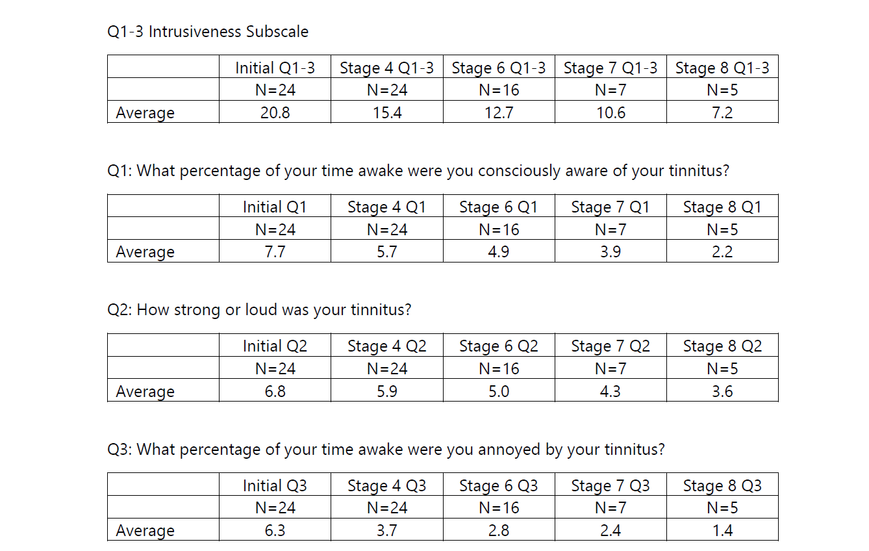
Fig 1
Expectations vs Outcomes for each of the Intrusiveness Subscale components:
Q1: What percentage of your time awake were you consciously AWARE OF your tinnitus? There is an expectation that conscious awareness of tinnitus significantly reduces using CBT4T.
- Fig 1 Q1 indicates a reduction by approximately 25% (7.7 > 5.7) by Stage 4; by approx 35% (7.7 > 4.9) by Stage 6; approx 50% (7.7 > 3.9) by Stage 7; approx 70% (7.7 > 2.2) by the end of the CBT4T process at Stage 8
Q2: How STRONG or LOUD was your tinnitus? There is limited expectation of significant reduction in tinnitus loudness being a result of Cognitive Behaviour Therapy. There is, however, expectation that "little and often, regular and consistent" breath work and relaxation daily routine has a very significant impact by regulating a dysregulated nervous system, that in turn has the effect of reducing tinnitus loudness perception heightened because of high levels of arousal causing stress/anxiety symptoms. Note: hearing aids can also provide significant benefit when tinnitus coincides with an aidable hearing loss
- Fig 1 Q2 indicates a reduction by approximately 10% (6.8 > 5.9) by Stage 4; by approximately 25% (6.8 > 5.0) by Stage 6; approx 35% (6.8 > 4.3) by Stage 7; approx 50% (6.8 > 3.6) by the end of the CBT4T process at Stage 8
- Fig 1 Q3 indicates a reduction of approximately 40% (6.3 > 3.7) by Stage 4; by approx 55% (6.3 > 2.8) by Stage 6; approx 60% by Stage 7; approx 80% (6.3 > 1.4) by the end of the CBT4T process at Stage 8
End note: The study is on-going. Results for each TFI subscale will be published in due course